


How SpaceX Could’ve Easily Avoided the Crash
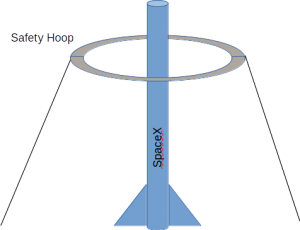 The recent SpaceX failure could have been easily avoided by using a cheap simple device they could have figured out in a few minutes by using Predictive Innovation.
The goal of landing the rocket vertically is both to reuse the rocket on Earth but also to develop the ability to land and return from the Moon, Mars, or asteroids to be mined. So they don’t want to only avoid damaging the rocket during landing, they want to build a rocket that is flexible enough to take off, land, and take off again on a wide range of surfaces. A lot can be learned from failures but there is no point destroying the rocket just to learn a little more.
What is the cheap simple solution for SpaceX?
The solution is like a large basket ball hoop over the landing pad. The rocket would land the same way and in the same place but first go through the hoop. The hoop should be large enough to not interfere with positioning and landing but small enough and high enough to catch the rocket if it tipped over. This protects the rocket from smashing on the landing pad and exploding. It would also allow all the data to be collected to learn how to land without the hoop. At the point the rocket falls over the experiment failed so nothing new can be learned. No point in risking damage to the rocket after the lesson is learned.
There is even a similarly cheap & easy way to use this concept for landing on uncharted territory such as Mars. I know that Elon Musk likes using first principles to innovate. The first principles of information is the basis of Predictive Innovation. Elon, give me a call, I also have a patented way to make solar panels for $0.25 / kW and a way to turn eWaste in to precious metals and plant food using 1/10th the energy of other less environmentally friendly systems.
P.S. This offer isn’t exclusive to Elon, unless he calls me first 😉
P.P.S. I can also help your organization with your seemingly impossible problems with a 100% guarantee.
Infinite Supply, the Problem with Copyrights & Patents
In a comment to Economics Of Abundance Getting Some Well Deserved Attention a reader complained that there isn’t an infinite supply of good books, good music, and movies. This is flatly false, there’s an infinite supply of any intellectual property and it can be mathematically proven. How is that for being emphatic?
Don’t fear I’m going to back up that statement and do the following:
- Prove there is an infinite supply of information.
- Show some reasons why Copyrights & Patents are logically flawed.
- List one form of intellectual property that is real and very valuable.
Digital media makes my point very clear. When you digitize a song, book or movie you convert it into numbers. And how many numbers are there? Infinite, you can keep counting forever. Computers store everything as a series of electrical impulses. We think of those as 1’s and 0’s. So inside a computer the music, videos, books and everything else is just a big number.
If you converted the phrase “infinite supply” into a stream of ones and zeros the way the computer sees it this is what it looks like:
01101001 01101110 01100110 01101001 01101110 01101001 01110100 01100101 00100000 01110011 01110101 01110000 01110000 01101100 01111001
As you look at that I’m sure it looks like a meaningless number. And that is the point. That phrase, “infinite supply” is just a meaningless number to a computer. Now look at this article. Up to this point it is 1,462 letters. When I save it on my computer it’s converted to a stream of 1’s and 0’s, it’s just a number. And like every number you could start at 1 and count up to the number equivalent of this article.
To count to the number that represents “infinite supply” you would pass “infinite supplx” and “infinite supplw”. You would also pass “supply”, “infinite”, “finite”, “in” and “a” and every possible combination of letters up to the 15 letter combination that make “infinite supply”. That is 2,954,312,706,550,833,698,643 combinations if we only include the letters “a” through “z” and blank space.
Read more
 Predictive Innovation Training
 Predictive Innovation: Core Skills Book
 RoundSquareTriangle.com